

Nearshore software development in Mexico has become one of the most key strategies of companies in the U.S. and developed countries. Companies are always seeking out methods to cut expenses, boost development rate and discover proficient technical employees without sacrificing quality. Mexico has become a very attractive nearshore destination due to its unique blend of low cost, proximity and technological expertise. Mexico is a much more convenient place to collaborate, as opposed to the traditional offshore destinations, which are unreachable and difficult to coordinate because of the time zone, and it is very attractive for start-ups, medium and large companies.
Understanding Nearshore Software Development
Nearshore software development is outsourcing software development projects to the nearby or neighbouring country that has cultural compatibility and similar time zones. One of the best nearshore destinations in the U.S. is Mexico. Nearshore teams are preferred in businesses for tasks such as enterprise systems, cloud-based application development, mobile application development, SaaS platforms, website development, etc. The main purpose is to cut down on operational expenses and keeping in touch with each other as well as providing high standards of development. It is unlike offshore outsourcing, where businesses may face communication delays as a result of huge time zone differences between their team and its overseas counterpart, such as working with a group in India or the Philippines.
Why Mexico is a Leading Nearshore Destination
Mexico is one of the premier nearshore software development destinations thanks to a number of strategic factors. One thing that is important is the proximity to the U.S. – Meetings can be held in person if needed, and are just a short flight from the major cities in the United States, through many tech cities in Mexico, such as Mexico City, Guadalajara and Monterrey. This nearness can also make project management easier and help to build more fruitful business relationships.
One of the other benefits is the time zone alignment. In Mexico, developers are involved in the work at times that are similar or overlapping with those of their U.S. clients, enabling them to communicate with the clients in real time. This cuts down on the lag time that is usually associated with offshore teams, and helps decisions to be made in a timely manner. Moreover, Mexico has focused a lot on the technology education sector, creating thousands of new software engineers annually that are taught modern programming languages, frameworks and cloud technologies.
Benefits of Nearshore Software Development in Mexico
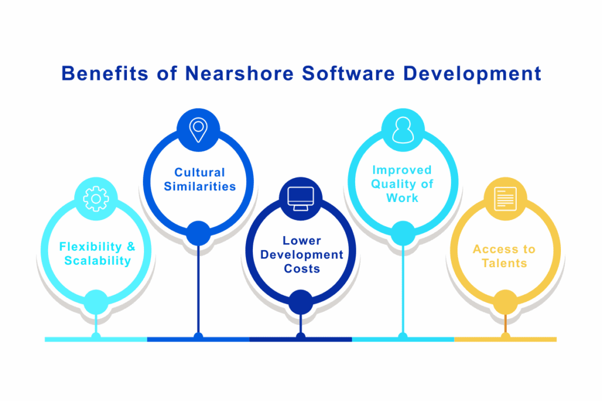
Cost efficiency is one of the main reasons that companies opt to choose Mexico. Software developers in Mexico are not as costly as software developers in the United States, but they are still of high quality. Thus, the businesses can reduce the development costs but still not affect their technical performance. This cost benefit can directly boost profits for many companies and enable them to put more resources into innovation and expansion.
What’s also great is the fact that they have an excellent staff to offer. The creators of the Mexican software know the most popular technologies, such as JavaScript, Python, Java and. The platforms are NET, React, Angular and cloud-based platforms such as AWS and Azure. Many are also familiar with working with international clients and thus can develop a greater understanding of international development standards and expectations.
Moreover, it is easier to communicate with the team when outsourcing is nearshore than with an offshore outsourcing team. Due to the overlapping working hours, teams can have real-time meetings, have daily stand-up meetings and quickly address issues without any long wait. This will save in the project’s pace and minimize miscommunication in the course of the development cycles.
One of those benefits that is not often realized is that of cultural compatibility. Mexico has many similarities in the workplace and business with the United States, such as communication style, work ethics and agile development. This can make partnership a more like collaboration of an in-house team than a vendor.
Services Offered by Mexican Software Development Companies
Mexico-based nearshore software development firms offer services to cater to nearly every facet of software development in today’s era. Web development is one of the most popular services provided by web teams, which creates dynamic web pages, business portals and complex web applications. Mobile application development is also a great demand with native and cross-platform mobile application development for both Android and iOS.
There are also many firms that outsource entire software solutions like enterprise resource planning (ERP) and customer relationship management (CRM) solutions, in addition to SaaS platforms. Having good back-end architecture, and being scalable, is essential and Mexican developers are getting better at delivering those two.
There are also various UI/UX design services available, aside from development. The design teams are committed to creating user-friendly interfaces, improving users’ interaction and product experience. Furthermore, with companies moving to cloud platforms, the use of cloud computing and DevOps services is becoming more common. Businesses can benefit from the expertise of Mexican engineers in cloud migration, server management, automation, and continuous integration and delivery (CI/CD) pipelines, enabling them to keep up efficient development processes.
Nearshore Software Development Rates in Mexico
The most interesting about nearshore outsourcing in Mexico is the pricing. There is a cost associated with dev’s based on their experience/expertise and the needs of the project. The hourly costs for junior developers in Mexico are on average, $20 to $35, mid-level developers $35 to $55 and senior developers can have an hourly cost of $55 to $80.
The savings are substantial when compared to the cost of development in the U.S. which is $100 to $200 an hour. The bottom-line savings enable businesses to expand development staff more effectively, without putting undue strain on the budget. But ‘price’ is not the only factor as the communication, technical expertise and reliability of the development partner are also critical.
Nearshore vs Offshore Software Development
Often companies interested in outsourcing their software projects will make comparisons between Nearshore and Offshore software development models. Some of the advantages of the nearshore development in Mexico are the time zone, communication and collaboration. Real-Time collaboration is a positive feature for teams since it assists in cutting down delays and heightens productivity.
Offshore development, which is typically in countries like India or the Philippines, on the other hand, is lower cost, but also has time zone issues and slower interaction cycles. Offshore team is an option for some projects but nearshore development is best for projects that demand a lot of communication, agile workflows, and close collaboration.
Challenges of Nearshore Software Development in Mexico
While nearshore software development in Mexico offers numerous benefits, it also has its challenges. The primary problem is that there’s a huge competition for talent, with the need for skilled developers being ever increasing. This may make it difficult for businesses to be able to hire the best engineers in time.
Another issue is that in some instances, language barriers can be an issue, but many Mexican developers are proficient in English. But even so, it’s crucial to have clarity in communication between individual teams and their experience in dealing with international clients.
Security and safeguarding of intellectual property are also key factors to be taken into account. Any company before beginning any project must make sure that they have legal agreements, NDAs and data protection measures in place. Also, not all development vendors are of the same quality; the choice of the outsourcing partner is crucial.
How Companies Successfully Use Nearshore Teams

For companies that are successful, the secret lies in their approach to operating with a nearshore team in Mexico. Agile development methodology is often employed to be flexible and to deliver faster. Communication is regular, including daily stand ups, sprint planning and sprint progress meetings, which help to meet the business goals.
Documentation is also a key element in eliminating misunderstandings and ensuring everyone is on the same page, both within your team and without. It doesn’t take much effort for companies to find out the best vendor by looking through vendor portfolios, reading client reviews or assessing the technical skills of the vendor.
Industries That Benefit from Nearshore Development in Mexico
Mexico’s nearshore software development services have played a key role in numerous industries. Nearshore teams are brought on by the fintech sector to develop safe financial applications and banking platforms. Patient management systems and digital health solutions are developed in the healthcare industry. The backbone of eCommerce businesses is scalability, enabling online transactions and interactions with customers. Logistics companies are utilizing software systems for shipment tracking as well as supply chain management. Collaborating with a nearshore team has numerous advantages, even for startups, in developing a minimum viable product and bringing the product idea to the market quickly.
Future of Nearshore Software Development in Mexico
But the future of nearshore software development in Mexico seems bright. The country is investing in the education of technology, and digital facilities; this is improving the number of skilled developers. At the same time, the demand for outsourcing services has been increasing across the globe due to the trend of remote and hybrid working.
Furthermore, the Mexican developers are discovering that new technologies, such as artificial intelligence, machine learning, cloud computing and blockchain, are providing new opportunities. With many U.S. companies interested in the development options Mexico offers at cost-effective and efficient rates, Mexico is well positioned to maintain its leading position as a near shore development destination in the world.
Conclusion
Mexico’s location and its technical skills make it an excellent choice for nearshore software development, particularly for companies seeking cost advantages. In addition to the expertise and geographical advantage that Mexico offers, the cost savings make it an ideal place for companies to take advantage of nearshore software development. It helps in reducing the expenses of the companies and yet maintaining the level of development standards, which helps in providing good communication. There are some issues such as talent competition, vendor selection, but the positive side is still more appealing which makes Mexico one of the most attractive destinations to outsource software development projects. The future of the software industry in Mexico is bright; this industry’s participation in the global software industry is expected to grow with the advancement of technology.
Frequently asked questions
1. What is nearshore software development in Mexico?
It’s outsourcing software development to Mexican developers that are near to the U.S. This helps the companies to cut cost and enhance communication.
2. Why is Mexico popular for nearshore outsourcing?
Mexico’s skilled developers, low rates and close time zone to the U.S. makes collaboration and working together easier and faster with the developers.
3. Is software quality good in Mexico?
Of course, there are numerous Mexican developers who will follow international standards and use modern technologies to develop quality software solutions.
How much does it cost to develop near the coast in Mexico?
Generally, rates range from $20 to $80 per hour, varying by experience, project size and project needs.
5 What services can be outsourced to Mexico?
Web development, mobile application, SaaS, UI/UX design, cloud solutions outsourcing – these are all offered to businesses.